

The Invisible Infrastructure of Small Towns: Why Main Street Needs More Than a Facelift
Julia Henley
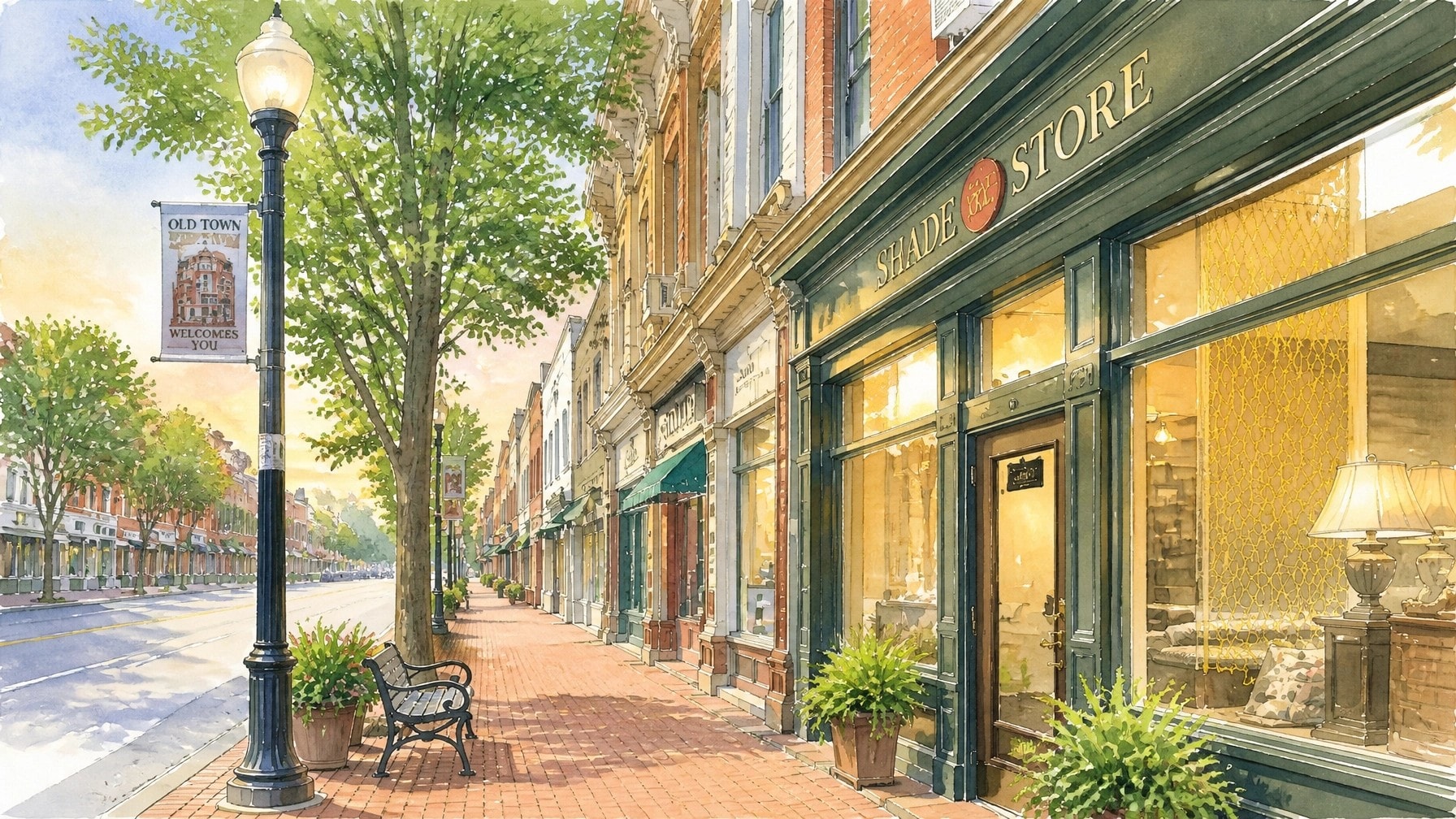
There is a familiar ritual that takes place in regional towns across the country when economic anxiety sets in. If the community is fortunate, there will be action: civic leaders commission a downtown study. Welcome banners appear across intersections. Storefronts receive new awnings, historic facades are restored, signs are improved, and planters arrive on the corners. Sidewalk seating, cafés, public art, trees, and landscape buffers invite people to reclaim the public realm. A festival or seasonal event gives residents a reason to return. These actions are sometimes dismissed as a Main Street facelift, but that dismissal is too easy. Visible change matters. It helps people see possibility, learn the story of a place, and begin to recognize a district as somewhere worth visiting and caring for.
The problem is not the banner, the awning, or the event. The problem is stopping there. A fresh coat of paint cannot, by itself, solve a structural disconnect. When public improvements are treated as the whole strategy rather than the beginning of a longer civic process, we mistake the invitation for the destination. The work is to use these visible signals to build the deeper social, ecological, and economic systems that allow a place to endure.
From Visible Invitation to Invisible Infrastructure
A thriving downtown relies not on superficial decoration alone, but on what I call invisible infrastructure: the complex, interconnected web of social trust, ecological integration, human-scale proportions, and economic resilience that quietly holds a community together. Simply? Places to gather, lots of trees and landscaping, connections that do not require cars, and multiple, connected destinations.
The first actions are often practical and visible. Define the area, even if its boundaries are fuzzy because of gaps, sprawl, highway edges, recent development, or contention between the activists who struggle to agree on what is “the Social District” or “the Main Street.” Then, yes, restore the facade that gives a block memory. Add trees, bollards, bike racks, benches, rock walls, decorative fences, planters, and landscape to buffer traffic. Provide seating, cafés, art, and small gathering places along the sidewalk. Host an event that brings people into contact with the street and with one another.
These actions are not superficial when they are connected to a larger intention. They educate the public about the character of a district. They help merchants, residents, and visitors see relationships that may have been hidden by traffic, vacancy, or neglect. They begin to brand a place — not as a marketing exercise alone, but as a shared story about what the community values.
The next question is who carries that story forward. In most towns, the answer cannot be a consultant or municipal department acting alone. A collaborative, citizen-led group can begin the work, and, with municipal leadership, that public-private partnership can lead to a better future for the community. Walking the area, identifying assets and gaps, gathering local history, listening to business owners and residents, and creating a sequence of achievable improvements all matter. Municipal partnership matters because public space, maintenance, traffic, trees, signage, and permitting require institutional support. Citizen leadership matters because a place is more likely to endure when the people who use it have helped define it.
This is how a visible facelift becomes invisible infrastructure. The banner opens the conversation. The sidewalk gives it a place to happen. The trees make it comfortable. The event creates a shared memory. The citizen group and municipality provide continuity. Investment follows, when zoning allows.
Restoring the Human Scale
Beginnings are not the same as stewardship. The first phase of Main Street work is often energetic, visible, and grant-funded: banners go up, facades are painted, an event draws a crowd. That phase matters because it builds confidence and momentum. Long-term stewardship is quieter and harder to fund. It is the ongoing maintenance of trees and sidewalks, the steady relationship between property owners and municipal staff, the rotation of leadership in the citizen group, and the discipline to keep measuring whether the street serves daily life, not just special occasions.
Historic downtowns were built around the locomotive speed of the human body: a stride of three miles per hour, a visual field attuned to storefront windows, cornices, and doorways, and a spatial rhythm where blocks averaged three hundred feet. When we introduce wide, high-speed arterial lanes through the heart of a small town, we rupture this human scale. Cars become insulated capsules barreling past a blur of brick, while pedestrians are relegated to narrow, noisy strips of concrete.
True revitalization begins when we reclaim the street as a shared public room rather than a highway corridor. That means narrowing travel lanes to calm traffic and make crossings intuitive and safe; reallocating excess asphalt to expanded sidewalks, outdoor seating, and green infrastructure; and keeping large, front-loaded surface parking lots from breaking the continuous street wall. When you walk down a street designed for human presence, your heart rate slows, your eyes take in architectural details, and you feel an invitation to stop, converse, and linger. That psychological shift is the prerequisite for economic exchange.
The Ecology of Commerce and Culture
A sustainable Main Street is never just a collection of retail shops; it is the cultural heartwood of its surrounding region. Towns connected to their surrounding landscapes — whether the sweeping bluffs of the Driftless or the agricultural, lakes, and river basins of the Midwest — possess a distinct authenticity that cannot be franchised. When a small town aligns its economy with its regional ecology, local craftspeople, makers, outfitters, and growers find a physical home that reflects their ethos. This interconnected model ensures that money circulating on Main Street supports local enterprises, preserves historic fabric, and reinforces regional pride.
Toward a Quiet, Enduring Resilience
We must abandon the panic of the quick fix while honoring the work that beginnings require. The challenges facing our regional towns — demographic shifts, economic consolidation, and infrastructural aging — cannot be solved by a weekend festival or a new coat of paint on a municipal sign. But perhaps that is the start of something better.
True renewal requires calm urgency and deliberate craftsmanship. It asks us to look at our downtowns not as investments waiting to flip, but as legacy systems entrusted to our care for a brief span of time. The visible work matters: the banner, the restored facade, the tree, the café chair, the public artwork, and the event that brings people together. But those gestures become durable only when they are connected to shared stewardship. By aligning our architecture with human dignity, our streets with natural pacing, and our civic life with mutual responsibility, we build places that do more than survive economic cycles. We build places worth loving.